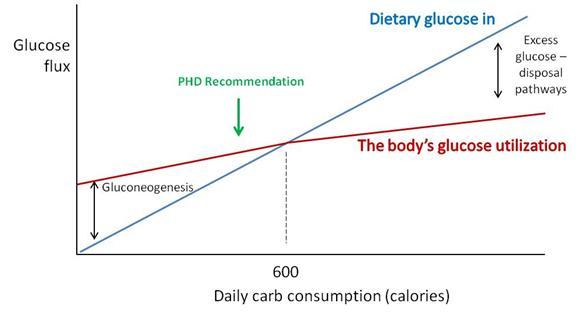
I took a fresh look at the "dietary glucose in" vs "glucose utilization" chart:
[align=center]
[/align]
It seems Jaminet is basing the chart on the standard 2000 calories, so the 600 calories crossover point is 30% and the 20% calories that he now claims PHD targets (as opposed to 30% in the book) is actually only 100 grams (not 75 grams which I had assumed) and appears at odds with the 125 minimum which is also stated in the book. 125 grams only equates to 25% at 2000 calories. The inconsistency is annoying.
Also, neglected to be clarified is whether or not this intake is net carbohydrates devoid of fiber or non-starchy vegetables, or total carbohydrate intake. If it is the former -- as I suspect -- it frees up even more calories for filling in with even more fat. It is a bottomless fat pit!
So essentially so far, as a rule of thumb, the PHD diet goes like this:
[align=center]75 grams min to 150 grams max of protein per day.
100 grams min to 150 grams max of carbohydrates per day.
55 grams min of fat per day.[/align]
At the minimums, it is only 1195 calories, so the maximum fat intake should be ad libitum up to the daily calorie requirements. That is also not addressed by PHD, so you are left wondering what the optimal daily calorie requirement is. I am quite satiated on just <1500 calories a day with no need to load up on the fat. But surely, there has to be a hormetic response to calorie intake as well.
Also unclear is with [net] carbohydrate intakes below 30%, how much extra protein is needed above the muscle-preserving minimum to make up the gluconeogenesis difference.
This week I gave up on shooting for three meals a day. Just too much food volume and cleanup work in too short a period of time. Far easier to up the fat content of two meals and not feel deprived by stretching only 1T of fat total per meal among cooking, starch and veggies.