Page 1 of 1
Re: Money: What It Is and How It Works
Posted: Tue Oct 20, 2015 10:16 pm
by MachineGhost
TennPaGa wrote:
I recognize that some here will think Hummel is crazy.

He's not crazy, just wrong about a few minor things. I think this may become the go-to layman's guide to understanding money as Roche is too technical. This is golden:
http://wfhummel.cnchost.com/moneyandcredit.html
It's always curious to me why people feel the need to insert their ideology when describing how the financial system works.
Re: Money: What It Is and How It Works
Posted: Wed Oct 21, 2015 3:59 am
by Libertarian666
He is completely wrong in his definition of money:
"In essence, money is credit that is widely accepted as a medium of exchange."
and therefore the rest of that is nonsense.
Money is not credit and credit is not money.
Credit is the right to receive money, whereas debt is the obligation to pay money.
Let's assume that I want to buy something from you. I can either buy it from you on credit, meaning I promise to pay you a sum of money later, or with cash, meaning I pay you now. These are clearly distinct situations that he is conflating.
Hope that helps.
Re: Money: What It Is and How It Works
Posted: Wed Oct 21, 2015 5:49 am
by Mountaineer
Libertarian666 wrote:
He is completely wrong in his definition of money:
"In essence, money is credit that is widely accepted as a medium of exchange."
and therefore the rest of that is nonsense.
Money is not credit and credit is not money.
Credit is the right to receive money, whereas debt is the obligation to pay money.
Let's assume that I want to buy something from you. I can either buy it from you on credit, meaning I promise to pay you a sum of money later, or with cash, meaning I pay you now. These are clearly distinct situations that he is conflating.
Hope that helps.
Is not cash, or a bond, or a stock certificate, or the electrons that represent them, just a promise that you can use the piece of paper to obtain services or merchandise (or even a gold bar or silver coin, i.e. a sum of money) at a later time?
... M
Re: Money: What It Is and How It Works
Posted: Wed Oct 21, 2015 11:05 am
by MachineGhost
TennPaGa wrote:
From the viewpoint of an individual, I would agree with Libertarian666's definition. But I think Hummel is taking a broader, systemic view. In that context, Hummel's definition is accurate. Practically speaking, all money is simply a bunch of IOU's.
I should probably stay out of this one, but money is just a transmission mechanism for exchanging the metaphysical concept of value for assets or consumption of products/services. It reflects the current purchasing power value as determined by free market participants at any point in time. One of the things that is unique about money historically is that it never keeps its purchasing power value, whether officially through legal proscriptions and/or unofficially via extralegality. In all cases, old money is eventually replaced with new money.
I think gold bugs have a conceptual problem with the reference values for determining what money is worth being disconnected from the money itself. They think that money needs to have special attributes that serve a role beyond being just a temporary exchange transmission mechanism. In other words, they want money itself to be a tangible asset rather than just a non-asset token. In the past, this was originally a tangible barter form (women sex slaves, cows, tally sticks, vegetables, precious metals, etc.) that then evolved to indirect warehouse receipts referencing said quantity of tangibles for value, that then evolved into intangible credit created only on demand as the economy needs it. In all cases, money always did what money does best, only the form changed.
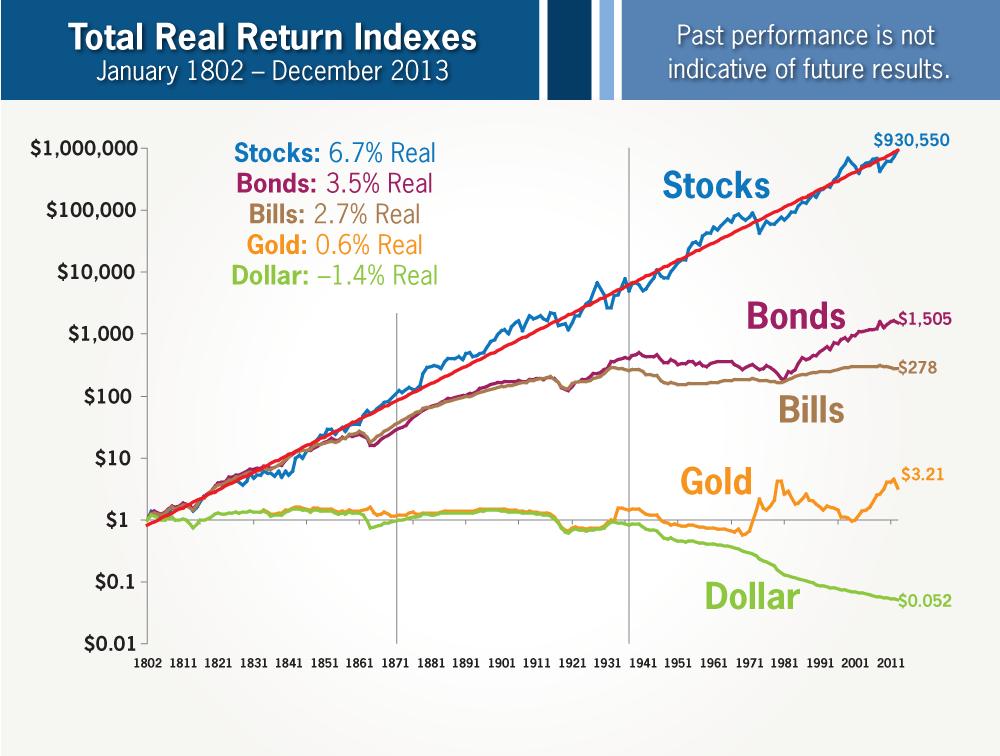
And from the PP perspective, you sure as hell do not want gold to ever be used as money again or it will lose most all of its value to be its own asset. All assets go up in value to a greater or lesser extent when money declines in value. It's an inverse relationship. For modern proof:
[img width=800]
http://www.marottaonmoney.com/wp-conten ... gure-1.jpg[/img]
One thing charts like these don't show is the scary volatility of "escape valves" when there is a price fixing scheme for money. If silver/gold-as-money is officially and legally fixed to a weight for $XX value, then you'll see the "escape valve" in higher and lower interest rates, unemployment rate, banking panics, Wizard of Oz labor unrest, trade deficits, austerity deflations, Depressions, etc.. rather than the value of the money itself adjusting, at least until the cork pops out of the bottle and there is an official devaluation.
Re: Money: What It Is and How It Works
Posted: Wed Oct 21, 2015 11:36 am
by Libertarian666
Mountaineer wrote:
Libertarian666 wrote:
He is completely wrong in his definition of money:
"In essence, money is credit that is widely accepted as a medium of exchange."
and therefore the rest of that is nonsense.
Money is not credit and credit is not money.
Credit is the right to receive money, whereas debt is the obligation to pay money.
Let's assume that I want to buy something from you. I can either buy it from you on credit, meaning I promise to pay you a sum of money later, or with cash, meaning I pay you now. These are clearly distinct situations that he is conflating.
Hope that helps.
Is not cash, or a bond, or a stock certificate, or the electrons that represent them, just a promise that you can use the piece of paper to obtain services or merchandise (or even a gold bar or silver coin, i.e. a sum of money) at a later time?
... M
That is a reasonable way to look at it. In the case of gold, however, the "promise" is more durable because it does not depend on the actions of one entity, as other promises (stock/bond certificates, paper money), but on the general propensity to value gold as such. E.g., if the Austrian empire (which no longer exists) issued paper money, it would be worth anything only as a collectible, but gold coins that they issued are still worth at least their gold content (aside from collectibility).
Re: Money: What It Is and How It Works
Posted: Wed Oct 21, 2015 11:38 am
by Libertarian666
TennPaGa wrote:
Mountaineer wrote:
Libertarian666 wrote:
He is completely wrong in his definition of money:
"In essence, money is credit that is widely accepted as a medium of exchange."
and therefore the rest of that is nonsense.
Money is not credit and credit is not money.
Credit is the right to receive money, whereas debt is the obligation to pay money.
Let's assume that I want to buy something from you. I can either buy it from you on credit, meaning I promise to pay you a sum of money later, or with cash, meaning I pay you now. These are clearly distinct situations that he is conflating.
Hope that helps.
Is not cash, or a bond, or a stock certificate, or the electrons that represent them, just a promise that you can use the piece of paper to obtain services or merchandise (or even a gold bar or silver coin, i.e. a sum of money) at a later time?
... M
+1
From the viewpoint of an individual, I would agree with Libertarian666's definition. But I think Hummel is taking a broader, systemic view. In that context, Hummel's definition is accurate. Practically speaking, all money is simply a bunch of IOU's.
Gold coins are not IOUs. They are money.
Which was my point.
Re: Money: What It Is and How It Works
Posted: Wed Oct 21, 2015 11:50 am
by MachineGhost
Libertarian666 wrote:
Gold coins are not IOUs. They are money.
Which was my point.
Can I go to the grocery store and pay for my groceries with gold coins or junk silver? Can I buy gas with gold coins or junk silver? Can I pay my dentist with gold coins or junk silver? How about my local, state and federal taxes? Can I buy a ticket to Trump's speech tonight in Iowa with gold coins or junk silver? They are
assets, not money.
Why is it you cannot perceive the reality literally in front of your eyes? It's been at least 44 years since gold or silver had any role as money:
https://www.youtube.com/watch?v=iRzr1QU6K1o
Okay, I'm done with this thread. Someone else can take up the torch.
Re: Money: What It Is and How It Works
Posted: Wed Oct 21, 2015 12:28 pm
by l82start
let me take a whack at it -- all money is credit -- all money is a widely accepted medium of exchange -- gold is both a medium of exchange and a form of credit and a commodity all at once. -- but gold is both money and not money at the same time
now because -- it
was a widely accepted medium of exchange -- it
is an accepted means of exchange with limits now, -- but because it has a looong history of wide acceptance -- it
could become fully money again under circumstances that made it necessary (even if only temporarily....)
venn diagram that mess...

Re: Money: What It Is and How It Works
Posted: Thu Oct 22, 2015 6:57 pm
by MediumTex
One interesting monetary arrangement is based on what you might call a "gun standard."
Under a gun standard monetary arrangement, if you challenge the authority of the issuer, you get shot (or blown up).
The U.S. has been on the gun standard since the early 1980s and it has worked surprisingly well (so far anyway).
Re: Money: What It Is and How It Works
Posted: Thu Oct 22, 2015 7:06 pm
by Libertarian666
Desert wrote:
At the beginning of the first link, he does a good job of explaining money:
Two Kinds of Money
Money is a token that is widely accepted as a medium of exchange. The token can be tangible like a coin or note, or intangible like a bank deposit. If the token is convertible on demand into a valuable commodity like gold, the token is known as commodity money. The exchange value of commodity money varies, but is normally greater than its value as a commodity. A precious metal coin is simply a token potentially convertible into the bullion that comprises it.
If the tokens are intrinsically worthless and inconvertible, the government must endow them with a special status to make them viable as money. Such tokens are known as fiat money. Except for collector’s items, all government-issued tokens today are fiat money. One must therefore avoid thinking in terms of commodity money to understand modern money.
In the era of commodity money, the issuer was constrained by the need to hold a sufficient supply of the underlying commodity. There is no such constraint in the case of fiat money. The value of fiat money therefore depends on the policies and actions of the issuer, normally the central bank of a country. The remainder of this essay applies to the monetary system of the U.S. and not necessarily to other countries.
Not a lot to disagree with there, right?
There certainly is.
This is totally incorrect. Tokens are objects that stand for other objects. What other object does a gold coin stand for? None: it is money itself.
And even more critically, he does not explain how fiat money can come into existence in the first place. Hint: look at a cupro-nickel "quarter" and a silver quarter. Why was the former made to look similar to the latter? That was a lot of extra work compared to just putting out a copper disk, so why did they do it?
Another example is a Federal Reserve note of 1928 vs. one of today.
1928:

Today:

What can you conclude from this?
Re: Money: What It Is and How It Works
Posted: Thu Oct 22, 2015 7:14 pm
by Libertarian666
MediumTex wrote:
One interesting monetary arrangement is based on what you might call a "gun standard."
Under a gun standard monetary arrangement, if you challenge the authority of the issuer, you get shot (or blown up).
The U.S. has been on the gun standard since the early 1980s and it has worked surprisingly well (so far anyway).
The US was on that standard under the Continental Congress. Other examples are all the countries where it has been illegal to use currencies other than the one issued by the government of that country.
How did that work out for them?
Re: Money: What It Is and How It Works
Posted: Thu Oct 22, 2015 7:19 pm
by MediumTex
Libertarian666 wrote:
MediumTex wrote:
One interesting monetary arrangement is based on what you might call a "gun standard."
Under a gun standard monetary arrangement, if you challenge the authority of the issuer, you get shot (or blown up).
The U.S. has been on the gun standard since the early 1980s and it has worked surprisingly well (so far anyway).
The US was on that standard under the Continental Congress. Other examples are all the countries where it has been illegal to use currencies other than the one issued by the government of that country.
How did that work out for them?
It's never been done like the U.S. does it today.
The guns at the disposal of the Continental Congress were nothing like the guns available to the U.S. government today.
Re: Money: What It Is and How It Works
Posted: Thu Oct 22, 2015 7:28 pm
by Libertarian666
MediumTex wrote:
Libertarian666 wrote:
MediumTex wrote:
One interesting monetary arrangement is based on what you might call a "gun standard."
Under a gun standard monetary arrangement, if you challenge the authority of the issuer, you get shot (or blown up).
The U.S. has been on the gun standard since the early 1980s and it has worked surprisingly well (so far anyway).
The US was on that standard under the Continental Congress. Other examples are all the countries where it has been illegal to use currencies other than the one issued by the government of that country.
How did that work out for them?
It's never been done like the U.S. does it today.
The guns at the disposal of the Continental Congress were nothing like the guns available to the U.S. government today.
The guns at the disposal of the Soviet Union were pretty good.
It didn't work for them either.
Re: Money: What It Is and How It Works
Posted: Thu Oct 22, 2015 7:42 pm
by MachineGhost
Desert wrote:
Not a lot to disagree with there, right?
If the tokens are intrinsically worthless and inconvertible, the government must endow them with a special status to make them viable as money. Such tokens are known as fiat money.
Absolute rubbish not supported historically.
There is no such constraint in the case of fiat money.
Rubbish also. Confidence is the binding constraint.
Re: Money: What It Is and How It Works
Posted: Thu Oct 22, 2015 8:00 pm
by MachineGhost
Libertarian666 wrote:
And even more critically, he does not explain how fiat money can come into existence in the first place.
Demand is what creates money or the need for it. Form matters not.
Libertarian666 wrote:
What can you conclude from this?
The former was a redeemable token. The latter is a non-redeemable token. Either way, both were/are money.
Re: Money: What It Is and How It Works
Posted: Thu Oct 22, 2015 9:17 pm
by MediumTex
Libertarian666 wrote:
The guns at the disposal of the Soviet Union were pretty good.
It didn't work for them either.
The Soviet Union wasn't attempting to maintain an international reserve currency, but I get your point.
A better example would probably be the British empire.
Re: Money: What It Is and How It Works
Posted: Thu Oct 22, 2015 9:39 pm
by Libertarian666
Desert wrote:
Libertarian666 wrote:
Desert wrote:
At the beginning of the first link, he does a good job of explaining money:
Not a lot to disagree with there, right?
There certainly is.
This is totally incorrect. Tokens are objects that stand for other objects. What other object does a gold coin stand for? None: it is money itself.
Tech, I'm just quoting a piece of your reply. I'm not sure why you disagree with the statement you put in bold. A gold coin, marked with $50 is a token, right? It represents (stands for) a value of $50. But it is also made of gold, so one could melt it down (or not) and sell it for its commodity (gold) value.
Now I can imagine a gold coin that is inscribed only with "1 oz gold." Then that would not be a token, assuming it was made of gold and weighed exactly one ounce. But it would not be generally recognized as money. Instead, it would be bought and sold using money, and held for its commodity or numismatic value.
I thought it was obvious that I was referring to gold coins under a gold standard. A $20 gold piece, when it was issued, was exactly $20 in money, not a token of anything.
Of course this doesn't apply when the mint makes gold coins for collectors with arbitrary face values having nothing to do with their gold content, but that's not what I was talking about.
Hope that helps.
Re: Money: What It Is and How It Works
Posted: Thu Oct 22, 2015 9:42 pm
by Libertarian666
MachineGhost wrote:
Libertarian666 wrote:
And even more critically, he does not explain how fiat money can come into existence in the first place.
Demand is what creates money or the need for it. Form matters not.
Libertarian666 wrote:
What can you conclude from this?
The former was a redeemable token. The latter is a non-redeemable token. Either way, both were/are money.
The point is that there is no example in history when an irredeemable token was introduced as money without its previously being a redeemable token, then the redeemability being defaulted on by the issuer. How do you account for that?
Re: Money: What It Is and How It Works
Posted: Fri Oct 23, 2015 12:33 am
by MachineGhost
Libertarian666 wrote:
The point is that there is no example in history when an irredeemable token was introduced as money without its previously being a redeemable token, then the redeemability being defaulted on by the issuer. How do you account for that?
The long evolution of money from barter of physical tangibles had the intermediate step of there being merchant, warehouse or grain receipts, but China just virtually skipped that part all together:
https://en.wikipedia.org/wiki/Banknote# ... aper_money
Even if what you say was true for Western history, it is irrelevant nowadays because money has evolved in form yet again. Essentially, credit creation and a medium of exchange have been merged together. We went through a tumultous period where the government and free market abused this privilege and the eventual result was the Federal Reserve Act to deal with the many negative behavioral issues.
I know what your ultimate point is though. You want the demon to be on the fiat form of money rather than excessive government borrowing. The latter is what destroys nations via loss of confidence, not fiat money. Otherwise China and other countries would have collapsed many times over. Gold being used as money has never stopped any government from collapsing.
Re: Money: What It Is and How It Works
Posted: Fri Oct 23, 2015 7:08 am
by Libertarian666
MachineGhost wrote:
Libertarian666 wrote:
The point is that there is no example in history when an irredeemable token was introduced as money without its previously being a redeemable token, then the redeemability being defaulted on by the issuer. How do you account for that?
The long evolution of money from barter of physical tangibles had the intermediate step of there being merchant, warehouse or grain receipts, but
China just virtually skipped that part all together:
https://en.wikipedia.org/wiki/Banknote# ... aper_money
Even if what you say was true for Western history, it is irrelevant nowadays because
money has evolved in form yet again. Essentially, credit creation and a medium of exchange have been merged together. We went through a tumultous period where the government and free market abused this privilege and the eventual result was the Federal Reserve Act to deal with the many negative behavioral issues.
I know what your ultimate point is though. You want the demon to be on the fiat form of money rather than excessive government borrowing. The latter is what destroys nations via loss of confidence, not fiat money. Otherwise China and other countries would have collapsed many times over. Gold being used as money has never stopped any government from collapsing.
What happened to
that wonderful invention? Oh yes, it became worthless, several times over. What a coincidence, eh?
Also, why do you say, "if what you say was true for Western history"? If you don't know that it is true, obviously you aren't very well-informed about the nature of money.
And money hasn't "evolved yet again", since credit and fiat money have been around for over a thousand years, as you just cited with the Chinese example. There is always someone to try the same doomed experiment again, because they don't know the track record of this "wonderful invention", or don't care. In fact, the French did it
twice in just the 18th Century!
I've also never claimed that using gold as money has ever stopped a government from collapsing. Governments will almost inevitably abase their currencies as a last resort before collapsing. However, that is beyond the ability of any individual to prevent.
My ultimate point is actually that individuals can prepare themselves for the collapse by keeping actual money to carry purchasing power through the collapse, as it will be acceptable in the new economic system that arises after the collapse. Paper "money" obviously will not serve that purpose, but gold will, and probably silver coins for small purchases.
Re: Money: What It Is and How It Works
Posted: Fri Oct 23, 2015 11:02 am
by MachineGhost
Libertarian666 wrote:
What happened to that wonderful invention? Oh yes, it became worthless, several times over. What a coincidence, eh?
Also, why do you say, "if what you say was true for Western history"? If you don't know that it is true, obviously you aren't very well-informed about the nature of money.
All money goes worthless, eventually. That has never been in dispute. That's what separates money from assets. But money being in fiat form is not what makes it go worthless. Note I'm not talking about intrinsic legacy value; I'm talking about confidence in money as money.
There's always exceptions as China points out, so I didn't want to make a potentially spurious claim that Western history always used forms of money that was always originally first redeemable tokens. I've got better things to do than go digging down through the detailed history of innumerous forms of Western money since 1661 when it is groking the Big Concept that really matters.
And money hasn't "evolved yet again", since credit and fiat money have been around for over a thousand years, as you just cited with the Chinese example. There is always someone to try the same doomed experiment again, because they don't know the track record of this "wonderful invention", or don't care. In fact, the French did it twice in just the 18th Century!
My bad. It worked great in China for centuries.
I've also never claimed that using gold as money has ever stopped a government from collapsing. Governments will almost inevitably abase their currencies as a last resort before collapsing. However, that is beyond the ability of any individual to prevent.
This is promising. You recognize that using commodity money is futile in preventing its eventual collapse from excessive credit issuance and/or government debasement. OTOH, you feel like there is nothing you can do. I disagree. First you must recognize what the core problem truly is and then you know what the answer will be is in terms of regulation and legislation. I admit it is a multi-faceted issue but definitely nothing will change if people do not become informed or stay misinformed.
My ultimate point is actually that individuals can prepare themselves for the collapse by keeping actual money to carry purchasing power through the collapse, as it will be acceptable in the new economic system that arises after the collapse. Paper "money" obviously will not serve that purpose, but gold will, and probably silver coins for small purchases.
No arguments here as that why we hold gold in the PP. But I'm just going to put it to down to semantics since you can't seem to grok the difference between money and an asset. You're anti-evolution if you think that we're going to roll back the clock to the BC era and that commodity money is going to become the new standard in the New World Order. That's Neo-Ludditism. Have you read the book
Against the Gods: The Remarkable Story of Risk by Bernstein? Because that is all about various fiat forms of money and its huge, huge pivotal role in our civilization becoming modern and advanced. No, such commodity money will be used as a temporary transition mechanism at best. Do we go back to using Windows 1.0 when Windows Vista turns out to be a piece of shit?