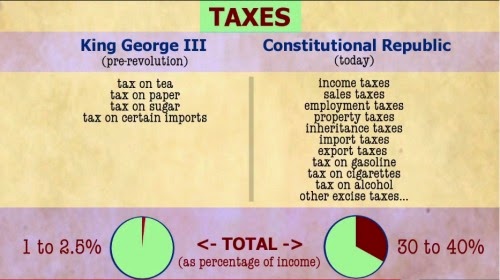
Just saying...
Moderator: Global Moderator





You have to normalize it by the increased standard of living. Then it will seem insignificant compared to Colonial times. Same with inflation.Ad Orientem wrote:
I guess we could use units of time required to mine an ounce of gold now vs then?Lowe wrote: How do you do that normalization? I don't even understand how they got the percentage-of-income figures from a set of tariffs and excise taxes. It seems contrived.
I'm not sure this makes sense to me, as it implies that high taxes are a "cost of doing business" to live in a modern, industrialized nation. There are plenty of countries with high standards of living with tax burdens that are far lower than ours. Compared to the USA, Singapore for example has a much lower income tax, much lower property tax, lower corporate tax, and no taxes on capital gains, dividends, interest, or employment. Just about the only tax higher than over here is that on cars.MachineGhost wrote: You have to normalize it by the increased standard of living. Then it will seem insignificant compared to Colonial times. Same with inflation.
I suppose you mean we could measure incomes in gold, now and then. That seems fair.MachineGhost wrote:I guess we could use units of time required to mine an ounce of gold now vs then?Lowe wrote: How do you do that normalization? I don't even understand how they got the percentage-of-income figures from a set of tariffs and excise taxes. It seems contrived.
Real income doesn't always represent improved living standards. It has to be by a unit of time, since a decrease in time to do something represents improved productivity and hence an increase in living standards. So something like Total Factor Productivity or number of days/hours to travel between x city and y city. In theory, the combined taxes we pay now will be a smaller percentage of a modern reference measurement than the combined taxes were on the old reference measurement.Lowe wrote: I suppose you mean we could measure incomes in gold, now and then. That seems fair.
Then we express the tariffs and excise taxes in gold, and likewise the income taxes of today, plus all the additional tariffs, excise taxes, sales taxes, and property taxes of today. Then we boil each side down to one figure, effective income tax, and compare them. Except how do you do that?
City-states like that are parasites on the world's blue-water navy and reserve currency. They benefit without paying the full costs. U.S. taxpayers subsidize the whole f*cking world, literally.Pointedstick wrote: I'm not sure this makes sense to me, as it implies that high taxes are a "cost of doing business" to live in a modern, industrialized nation. There are plenty of countries with high standards of living with tax burdens that are far lower than ours. Compared to the USA, Singapore for example has a much lower income tax, much lower property tax, lower corporate tax, and no taxes on capital gains, dividends, interest, or employment. Just about the only tax higher than over here is that on cars.
Every person and government that has ever been and ever will be has benefited from various things without paying their full costs. It is a feature of life itself. Even here in the USA with our reserve currency and biggest blue-water navy in the world, we benefit from all kinds of expensive things without paying the costs of having to balance our budget or maintain friendly relations with anybody.MachineGhost wrote:City-states like that are parasites on the world's blue-water navy and reserve currency. They benefit without paying the full costs. U.S. taxpayers subsidize the whole f*cking world, literally.Pointedstick wrote: I'm not sure this makes sense to me, as it implies that high taxes are a "cost of doing business" to live in a modern, industrialized nation. There are plenty of countries with high standards of living with tax burdens that are far lower than ours. Compared to the USA, Singapore for example has a much lower income tax, much lower property tax, lower corporate tax, and no taxes on capital gains, dividends, interest, or employment. Just about the only tax higher than over here is that on cars.
It would be interesting to make a graph of this information, as it seems almost random. Among the top 10 countries in terms of tax revenue, we have highly desirable countries like Sweden and Norway, and we also have basket cases like Zimbabwe, Cuba, and Lesthoso.moda0306 wrote: And if you look at this list...
http://en.wikipedia.org/wiki/List_of_co ... age_of_GDP
... you find that being on the "low tax rate" end of the list doesn't give you a high chance of being an appealing country to live in. Singapore is almost the exception that proves the rule. (I know.. I know.. correlation =/= causation).
Most Western countries are in the higher-tax end of that list. Of those below 20% tax, the following countries are the ones I'd consider "good places to live" based on gut instinct.Pointedstick wrote:It would be interesting to make a graph of this information, as it seems almost random. Among the top 10 countries in terms of tax revenue, we have highly desirable countries like Sweden and Norway, and we also have basket cases like Zimbabwe, Cuba, and Lesthoso.moda0306 wrote: And if you look at this list...
http://en.wikipedia.org/wiki/List_of_co ... age_of_GDP
... you find that being on the "low tax rate" end of the list doesn't give you a high chance of being an appealing country to live in. Singapore is almost the exception that proves the rule. (I know.. I know.. correlation =/= causation).

moda,moda0306 wrote:Most Western countries are in the higher-tax end of that list. Of those below 20% tax, the following countries are the ones I'd consider "good places to live" based on gut instinct.Pointedstick wrote:It would be interesting to make a graph of this information, as it seems almost random. Among the top 10 countries in terms of tax revenue, we have highly desirable countries like Sweden and Norway, and we also have basket cases like Zimbabwe, Cuba, and Lesthoso.moda0306 wrote: And if you look at this list...
http://en.wikipedia.org/wiki/List_of_co ... age_of_GDP
... you find that being on the "low tax rate" end of the list doesn't give you a high chance of being an appealing country to live in. Singapore is almost the exception that proves the rule. (I know.. I know.. correlation =/= causation).
Singapore
Taiwan
Of those countries above 30%, here are my "gut instinct" good places to live:
Ireland
Canada
New Zeland
Luxembourg
Israel (gotta be some peaceful parts, right?)
Portugal
Spain
UK
Hungary
Netherlans
Iceland
Germany
Italy
Austria
Finland
Norway
France
Sweden
Belgium
Denmark
I'm really not trying to be unfair here... I think "high taxes" wins the correlation game. This is to say nothing too concrete about causation... but it would appear the evidence is against "low taxes cause safe, productive economies to naturally result," or whatever our lesson is supposed to be, here.
Also, one big thing we're not factoring in is state-owned businesses. If a government gets all the oil profits, they don't need, possibly, to tax much.
 ), your selection of Ireland, Israel, Iceland, Italy vs. Iraq, Iran, India, Ivory Coast, Indonesia?
 I'm mostly trying to say that low taxes and safe, productive societies are not incompatible. It appears that any type of society can have any type of tax rate. The highest taxes of all are imposed by Zimbabwe, one of the world's worst basket cases.moda0306 wrote: I'm really not trying to be unfair here... I think "high taxes" wins the correlation game. This is to say nothing too concrete about causation... but it would appear the evidence is against "low taxes cause safe, productive economies to naturally result," or whatever our lesson is supposed to be, here.



Did those countries always have high taxation, or did they have low taxes while they were becoming awesome, then afterwards/towards the end enact higher taxes?moda0306 wrote:
Of those countries above 30%, here are my "gut instinct" good places to live:
Ireland
Canada
New Zeland
Luxembourg
Israel (gotta be some peaceful parts, right?)
Portugal
Spain
UK
Hungary
Netherlans
Iceland
Germany
Italy
Austria
Finland
Norway
France
Sweden
Belgium
Denmark
I'm really not trying to be unfair here... I think "high taxes" wins the correlation game. This is to say nothing too concrete about causation... but it would appear the evidence is against "low taxes cause safe, productive economies to naturally result," or whatever our lesson is supposed to be, here.